
Chemical Protective Suits for Hazardous Waste Management: How to Select the Right Option
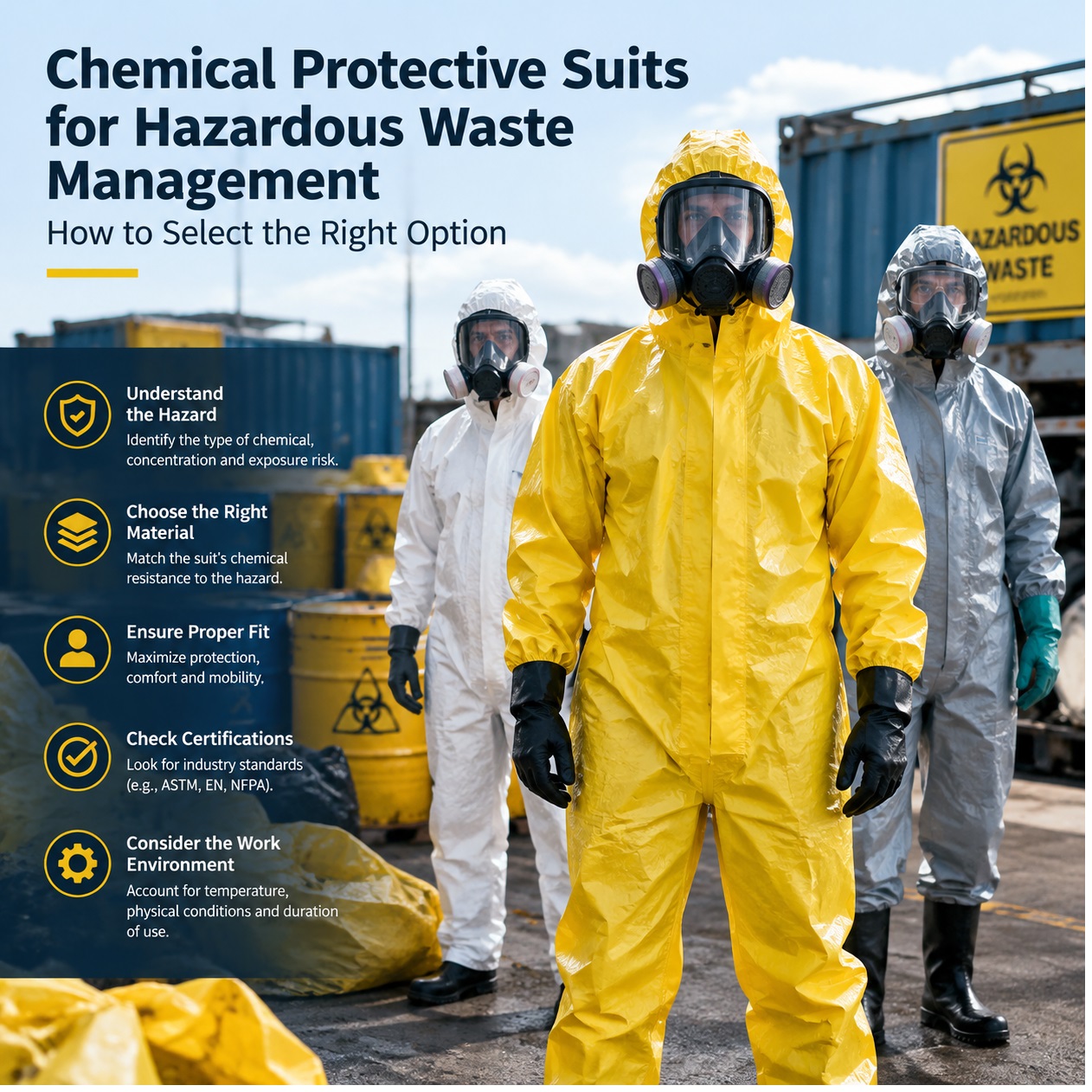 A hazardous waste site will humble the wrong suit in under five minutes. Not because the label lied, but because the selection process skipped the only question that matters: what exactly is the suit protecting against, for how long, and under what conditions?
Start with the waste, not the catalog. Before anyone talks about material weight, color, or price, get the Safety Data Sheet, the waste profile, and the process knowledge. Chemical name, concentration, mixture, temperature, physical state, pressure, splash potential, vapor potential, and expected duration of exposure. A suit that handles 10 percent sulfuric acid may fail against 98 percent sulfuric acid. A suit that resists one solvent may dissolve in another. Mixtures are their own animal. Waste streams rarely arrive as neatly labeled single chemicals.
The quiet killer is permeation. That is when a chemical moves through the suit material at a molecular level, without a visible hole, drip, or tear. You may not see it, smell it, or feel it until the exposure has already happened. Penetration is different: liquid or particles moving through zippers, seams, closures, or fabric gaps. Degradation is the material weakening, swelling, cracking, or losing strength. A serious supplier gives you permeation data, breakthrough times, and degradation ratings for the specific chemicals you handle. If all you get is the word resistant, keep shopping.
Material selection is not a brand loyalty contest. Tyvek-style fabrics are fine for dry particulates and light splash. Tychem, PVC, neoprene, butyl, Viton, Teflon, and multilaminate films each have chemical strengths and weaknesses. No single suit is a universal answer for hazardous waste management. The right approach is a selection matrix: waste stream on one side, suit model on the other, with test data in the middle. That matrix changes when the waste changes, when the task changes, and when the weather changes.
Construction details decide whether the suit performs in the real world. Seams must match the hazard. Heat-sealed and taped seams are typical for liquid and vapor protection. Stitched seams may be acceptable for dry particles, but they can wick liquids. Zippers need storm flaps and proper closures. Visors must resist chemical attack and fogging. Gloves and boots need secure interfaces, because a gap at the wrist or ankle is an open door. Exhaust valves, if present, must be compatible with the chemical and the breathing apparatus. Gas-tight chemical protective suits and liquid-tight suits are not the same thing. Fully encapsulating suits offer the highest barrier, but they also create the highest heat load and the toughest doffing challenge.
Know the protection levels. Level A is for the unknown or highly toxic vapor environment, usually with a fully encapsulating chemical-protective suit and self-contained breathing apparatus. Level B uses a chemical-protective suit with SCBA, often for splash or liquid hazards where vapor protection is less certain. Level C pairs a chemical-protective suit with an air-purifying respirator, but only when the contaminant, concentration, and oxygen level are known and acceptable. Level D is basically work clothing, not a chemical barrier. The suit is only one part of the ensemble. Respiratory protection, gloves, boots, and eye protection must work as a system.
Fit and heat stress are not afterthoughts. A chemical protective suit is a wearable microclimate. The more it blocks chemicals, the more it traps body heat. Heat stress can take down a healthy worker faster than a low-level chemical exposure. Cooling vests, hydration, work-rest cycles, and medical monitoring are part of selection, not extras. Sizing matters too. A suit that is too large snags on debris, catches on equipment, and creates gaps. A suit that is too small restricts movement, tears at the shoulders, and makes doffing dangerous. Crews should try on the exact suit model with the exact gloves, boots, and respirator they will use.
Certification helps, but it does not replace site-specific judgment. Look for standards such as NFPA 1991 for vapor-protective suits, NFPA 1994 for CBRN protection, EN 943 for gas-tight and non-gas-tight suits, EN 14605 for liquid-tight and spray-tight suits, and EN 13034 for limited splash protection. OSHA HAZWOPER requirements under 1910.120 set the training and program framework. A certification mark tells you the suit passed a baseline test. It does not tell you the suit is right for your waste, your task, your temperature, or your duration.
Training and decontamination often expose the weakest link. A suit that crews cannot don quickly, work in safely, and doff without touching contaminated surfaces is a liability. Buy from a supplier who supports donning and doffing drills, decontamination procedures, and disposal planning. Ask about lot traceability, shelf life, storage conditions, and replacement schedules. A suit that has been sitting in a hot truck for two years may not perform like the one in the test report.
When you compare quotes, ask hard questions. What permeation data do you have for my chemicals? What seams and closures are used? What sizes are available, and how do they fit over SCBA? What training comes with the order? How fast can you restock? What technical support do you offer when the waste stream changes? The cheapest suit is not cheap if it fails, if it causes heat exhaustion, or if it forces a costly shutdown.
The right chemical protective suit for hazardous waste management is not the thickest, the most expensive, or the one with the longest feature list. It is the one that matches the hazard, the task duration, the work environment, and the human inside it. Choose with data. Choose with training. Choose with a supplier who asks about your waste before quoting a price. That is how you select the right option, and that is how you keep crews protected when the job turns ugly.